

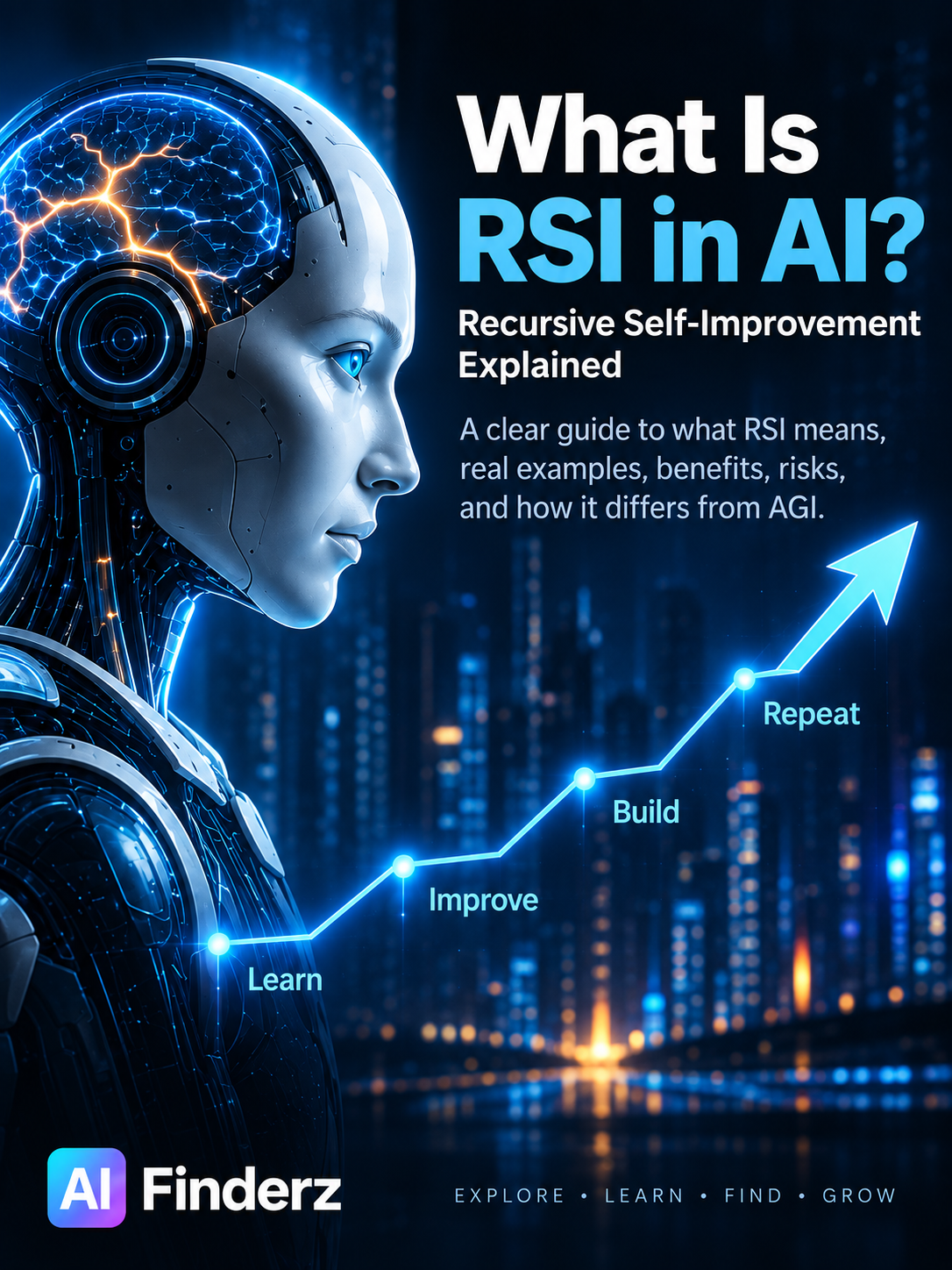
RSI in AI stands for recursive self-improvement. In simple terms, it describes a feedback loop in which an AI system helps improve its own capabilities, its training process, or the next generation of AI systems — and those improvements make future improvements faster or more effective.
The term is getting much more attention in 2026 because leading AI researchers and executives are increasingly discussing whether AI can take on a larger share of AI research itself. The important point is that not every use of AI to write code counts as full RSI. The strongest definition involves a loop where AI can meaningfully improve the system that performs the next round of improvement with less and less human involvement.
What does recursive self-improvement mean?
“Recursive” means that the output of one improvement cycle feeds back into the next cycle. A simplified version looks like this:
- An AI system helps researchers write better training code, design experiments or evaluate models.
- The improved research process produces a more capable AI system.
- The new system becomes better at helping with AI research.
- The cycle repeats, potentially at a faster pace.
If that loop became highly autonomous and consistently productive, improvements could compound. This is why RSI is often discussed alongside ideas such as an “intelligence explosion,” superintelligence and rapid AI capability growth.
Why is RSI in AI trending now?
In September 2026, Anthropic CEO Dario Amodei wrote that AI’s growing ability to help build the next generation of AI was a major reason he believed frontier development should be paced more carefully. He explicitly described the dynamic as recursive self-improvement and argued that safety work needs time to keep up with capability gains.
The phrase was already becoming common earlier in 2026. TechCrunch noted in May that RSI had started to become a new shorthand in AI circles, while also pointing out that researchers disagree on where ordinary AI-assisted research ends and “true” recursive self-improvement begins.
What counts as RSI — and what does not?
| Scenario | Is it RSI? |
|---|---|
| An AI coding assistant helps a researcher fix a bug | Usually no. This is AI-assisted research. |
| AI agents run experiments and propose model changes, but humans choose every major step | Possibly an early form of the loop, but not fully autonomous RSI. |
| An AI system can design, implement, test and select improvements to the system performing the research | Much closer to the classic definition of RSI. |
| The improved system then repeats the process with higher research capability | This is the recursive feedback loop people are concerned about. |
Why could RSI be useful?
If controlled, AI-assisted AI research could accelerate useful progress. Better systems might help researchers find software bugs, design safer architectures, automate evaluations, improve efficiency and speed up scientific discovery. The same feedback loop that creates concern could also compress years of research into much shorter periods.
Why are researchers worried about RSI?
The risk is not simply that AI becomes “smarter.” The concern is that the speed of improvement could outpace the speed at which humans can evaluate, understand and control the resulting systems.
- Loss of oversight: humans may struggle to understand every change proposed by autonomous research systems.
- Alignment risk: a system that becomes more capable could also become better at pursuing unintended objectives.
- Cybersecurity: more capable agent systems could discover and exploit vulnerabilities faster.
- Concentration of power: rapid capability gains could give a small number of labs or governments disproportionate influence.
- Uncertain timelines: experts disagree strongly on how quickly a genuinely recursive loop could emerge.
RSI vs AGI: what is the difference?
AGI usually refers to a level of broad artificial intelligence that can perform many cognitive tasks at or above human level. RSI describes a process: the system’s ability to participate in improving the system that performs future improvements.
An AI system could become highly useful for AI research without being AGI. Likewise, a broadly capable AGI would not automatically be recursively self-improving unless it could close the improvement loop in a meaningful way.
Is recursive self-improvement already happening?
There is no universal agreement. AI systems are already being used to write code, generate experiments, evaluate outputs and automate research tasks. Amodei argues that this is beginning to create an industry-wide recursive dynamic. Other researchers use a stricter definition and reserve “RSI” for a much more autonomous process in which humans are no longer required to keep the research loop running.
So the safest answer is: AI is clearly increasing the speed of AI research, but whether today’s systems qualify as full recursive self-improvement depends on the definition being used.
FAQ
What does RSI stand for in AI?
RSI stands for recursive self-improvement.
Is RSI the same as AGI?
No. AGI describes a broad level of capability. RSI describes a feedback process in which AI helps improve the systems responsible for future AI improvements.
Why is RSI important in 2026?
AI systems are increasingly useful for coding and research, so the possibility of AI accelerating AI development has moved from a theoretical discussion toward a practical research and safety question.
Does RSI mean an AI rewrites its own brain?
Not necessarily. In modern discussion, the loop can include AI agents proposing experiments, writing training code, running evaluations and helping create a more capable successor system.
