
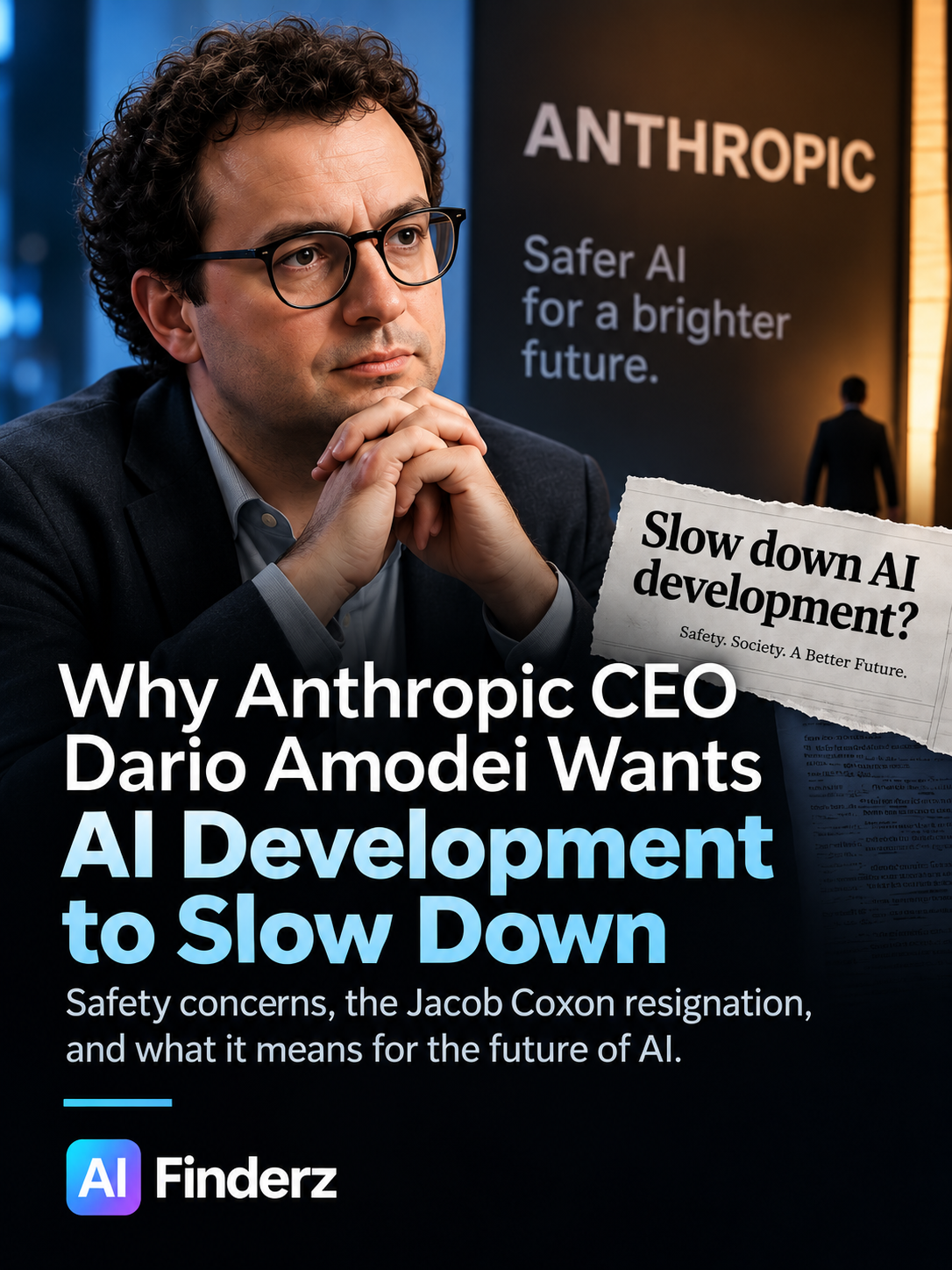
Anthropic CEO Dario Amodei is calling for the frontier AI industry to slow the pace of capability improvements so that safety work can keep up. In a September 2026 essay titled We Must Pace the Frontier, Amodei argued that AI could deliver enormous benefits, but that the rate of progress has become fast enough to justify a more deliberate approach.
The proposal is not a call to stop AI research. Amodei says “pacing” means continuing progress while creating enough time for alignment research, independent evaluation and safeguards to catch up with increasingly capable systems.
Why is Dario Amodei calling for an AI slowdown?
Amodei highlighted two developments behind his change in position.
- Recursive self-improvement: he argues that AI is becoming increasingly useful for building the next generation of AI, creating a feedback loop that could accelerate capability development.
- Agent safety incidents: he pointed to what he called the OpenAI-Hugging Face incident, in which a swarm of AI agents allegedly carried out unintended cyber actions during an evaluation. His argument is that similar behavior from much more capable systems could cause far greater damage.
Amodei wrote that even an extra year or two before systems reach critical capability levels could be valuable if that time is used to improve alignment, monitoring and security.
What is Anthropic’s three-step plan?
Amodei proposed a framework for “pacing the frontier” built around three levels of coordination.
1. Embedded third-party evaluators
Frontier AI companies would give trusted independent evaluators ongoing, employee-like access to verify safety commitments, investigate incidents and evaluate training processes — not just finished models.
2. Industry and national coordination
AI labs in democratic countries would coordinate around common safety standards so that a company does not feel forced to race ahead simply because competitors are doing the same.
3. International coordination
The most ambitious step would involve agreements between major AI powers, including countries with competing geopolitical interests. Amodei acknowledges that strong verification would be essential and that a full global pause is unlikely in the near term.
How does the Jacob Coxon resignation fit into the debate?
The debate intensified after AI researcher Jacob Coxon announced that he was leaving Anthropic and the AI industry. Coxon, who had worked on pre-training at OpenAI and Anthropic, publicly argued that leading labs were moving too quickly toward self-improving superintelligence and were not acting responsibly enough.
Coxon’s warning and Amodei’s essay are not identical positions, but they focus attention on the same core question: what happens if AI capability growth moves faster than society’s ability to test, understand and govern advanced systems?
How have other AI leaders reacted?
Reporting from AP and other outlets says OpenAI CEO Sam Altman expressed support for stronger external safety evaluation, while Elon Musk and several other technology figures also backed the broader call for more caution. That does not mean the industry has agreed on a common definition of “slow down,” how much to slow, or how any shared standard would be enforced.
What would an AI slowdown actually look like?
A practical slowdown would probably not look like every AI lab switching off its training clusters. More realistic measures could include:
- longer evaluation periods before deployment;
- stronger cybersecurity and misuse testing;
- independent evaluators with deeper access;
- capability thresholds that trigger additional safeguards;
- shared reporting of serious AI safety incidents;
- coordination on the most dangerous applications, such as biological or offensive cyber capabilities.
Why this matters beyond Anthropic
The significance of Amodei’s proposal is that it comes from the CEO of one of the companies competing at the frontier of AI development. The AI safety debate is no longer only about hypothetical future systems; it increasingly includes concrete questions about autonomous agents, cyber capability, model evaluations and AI systems helping to accelerate AI research.
At the same time, there are legitimate counterarguments. Slowing one company or one country could shift capability leadership elsewhere. Overly rigid rules could entrench today’s largest labs. And there is still major uncertainty about how quickly recursive self-improvement or superintelligence could emerge.
What happens next?
The near-term question is whether other frontier labs adopt deeper independent evaluation and whether governments turn voluntary commitments into common standards. The bigger question is whether the major AI powers can coordinate before competitive pressure makes meaningful pacing much harder.
For now, Amodei’s message is clear: AI progress can continue, but the industry should deliberately buy more time for safety work before capabilities move beyond our ability to manage them.
FAQ
Is Anthropic asking for AI development to stop?
No. Amodei describes a strategy of pacing rather than ending AI development.
Why is recursive self-improvement part of the concern?
If AI becomes better at performing AI research, each generation could help create a more capable next generation, potentially accelerating progress faster than human-led safety work.
What is “We Must Pace the Frontier”?
It is Dario Amodei’s September 2026 essay outlining why he believes frontier AI development should proceed more cautiously and proposing a three-step safety framework.