

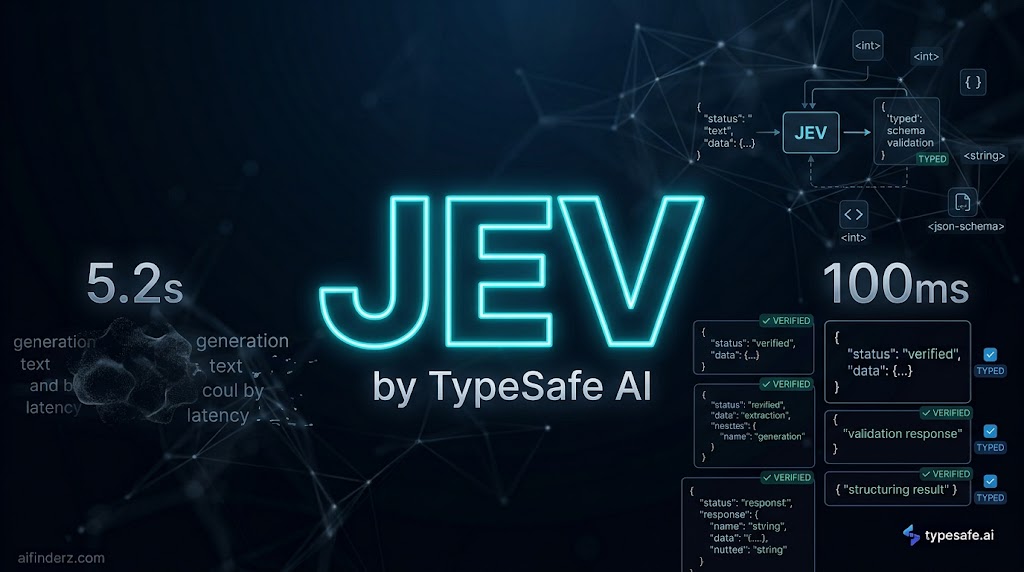
Jev by TypeSafe AI: The ChatGPT Co-Inventor’s Model That Skips the Chat
Jev is the first public model from TypeSafe AI, a San Francisco lab that came out of stealth on September 15, 2026 with $40 million in seed funding led by DCVC. Unlike ChatGPT, Claude or Gemini, Jev is not built to hold a conversation. It is built to sit inside software and return fast, typed decisions that other code can act on directly.
The launch has drawn attention mainly because of who built it: TypeSafe’s CEO and co-founder, Diogo Almeida, is a former OpenAI researcher and co-author of the InstructGPT paper, the research that laid the groundwork for ChatGPT. His pitch is that the same chat-optimized approach that made ChatGPT successful may be the wrong foundation for AI that runs inside production software.
What is Jev?
TypeSafe calls Jev a System One Model. Instead of generating free-form text one token at a time, Jev takes a structured question plus some context and returns a typed answer along with a calibrated confidence score. A workflow can then automatically proceed when confidence is high, or route the case to a human when it is not.
TypeSafe trained Jev using a new method it calls Reinforcement Learning for Calibrated Decisions (RLCD), distinct from the RLHF and RLVR techniques used to train conversational chat models and reasoning models. The company positions this as a deliberate departure from the RLHF work Almeida himself helped pioneer.
1. Typed, structured outputs
Jev does not write paragraphs. It returns a specific typed value, such as a category, a score or a yes/no decision, which is easier for software to consume safely than parsing free-form text.
2. Calibrated confidence scores
Every answer comes with an estimate of how confident the model is. Development teams can set thresholds so that only high-confidence decisions are actioned automatically, with everything else escalated for review.
3. Speed and cost
TypeSafe claims Jev answers in roughly 70 to 500 milliseconds, and reports workflow benchmarks that are dramatically faster and cheaper than comparable LLM-based pipelines. Published pricing sits around $42 per billion input tokens, with output tokens not billed separately.
4. Parallel, composable queries
Because Jev is built to be called programmatically, TypeSafe says it can generate large batches of decisions in parallel and let developers combine them into larger automated workflows, similar to composing functions in code.
What is Jev good for?
TypeSafe is pitching Jev for the kind of judgment calls that today either rely on brittle hand-written rules or on slower, more expensive LLM calls:
- Sorting or triaging incoming requests and tickets
- Scoring records, such as risk or lead-quality scoring
- Screening AI-generated outputs for jailbreak attempts or policy violations
- Real-time feature extraction and structured data labeling
- Automated branching logic in large-scale data or business workflows
What Jev is not good at
Jev is not designed to write, brainstorm, or hold a conversation. TypeSafe documents a working context of roughly 32,000 tokens, far smaller than the million-token windows advertised by some frontier chat models, which is a meaningful limit for anything beyond a single ticket, record or passage of text. It is also still in early access, so real-world reliability at scale has not yet been widely tested outside TypeSafe’s own benchmarks.
Jev vs. using an LLM for structured output
Developers already constrain LLMs with JSON mode or structured-output features to get parseable answers. TypeSafe’s argument is that this is a workaround rather than a native design choice: general chat models were optimized to satisfy human readers, not to produce calibrated, type-safe decisions, which the company says shows up as inconsistency and overconfidence in edge cases. Jev is built around typed decisions and confidence scoring from the ground up, at a fraction of the latency and cost TypeSafe reports for comparable LLM workflows.
Who should use Jev?
Engineering and platform teams building automated decision layers inside products are the core audience. Trust-and-safety teams may be interested in using it to screen content or AI outputs at low latency. Data and ops teams running large-scale classification or extraction jobs could use it to cut both cost and turnaround time compared with general-purpose LLM pipelines. Jev is not aimed at marketers, writers or casual users looking for a chat assistant.
Pricing and availability
Jev is currently available through an early-access waitlist rather than general availability. TypeSafe lists input-token pricing around $42 per billion tokens, with output tokens included at no extra charge, though early-access terms and pricing may still change as the product matures.
Bottom line
Jev is less a competitor to ChatGPT or Claude and more a bet on a new product category: AI built to be consumed by software rather than by people. Whether that category takes off will depend on how Jev performs once it moves beyond early access and into real production workloads.