
Last updated: October 1, 2026.
The Mike Rowe skilled trades AI impact discussion is gaining attention because the AI boom is creating a paradox: artificial intelligence may automate parts of office work, yet the physical infrastructure behind AI still requires large numbers of electricians, HVAC technicians, construction workers and other skilled trades.
Quick answer: Mike Rowe argues that the growth of AI and data centers could strengthen demand for skilled trades rather than eliminate those jobs. Recent U.S. labor projections also point to growing electrician employment as AI-driven electricity demand and data-center construction expand.
Why Mike Rowe is talking about AI and skilled trades
On October 1, 2026, Mike Rowe discussed the widening U.S. skilled-labor shortage and the effect artificial intelligence may have on career choices. Fox Business reported that Rowe said demand through the mikeroweWORKS Foundation had risen sharply and that AI appears to be changing how people think about work and training.
The core of his argument is not that skilled trades are untouched by technology. It is that many of the jobs required to build and maintain AI infrastructure remain physical, local and difficult to replace with software alone.
That includes work involving electrical distribution, cooling systems, construction, maintenance, fabrication and power infrastructure.
AI does not run without physical infrastructure
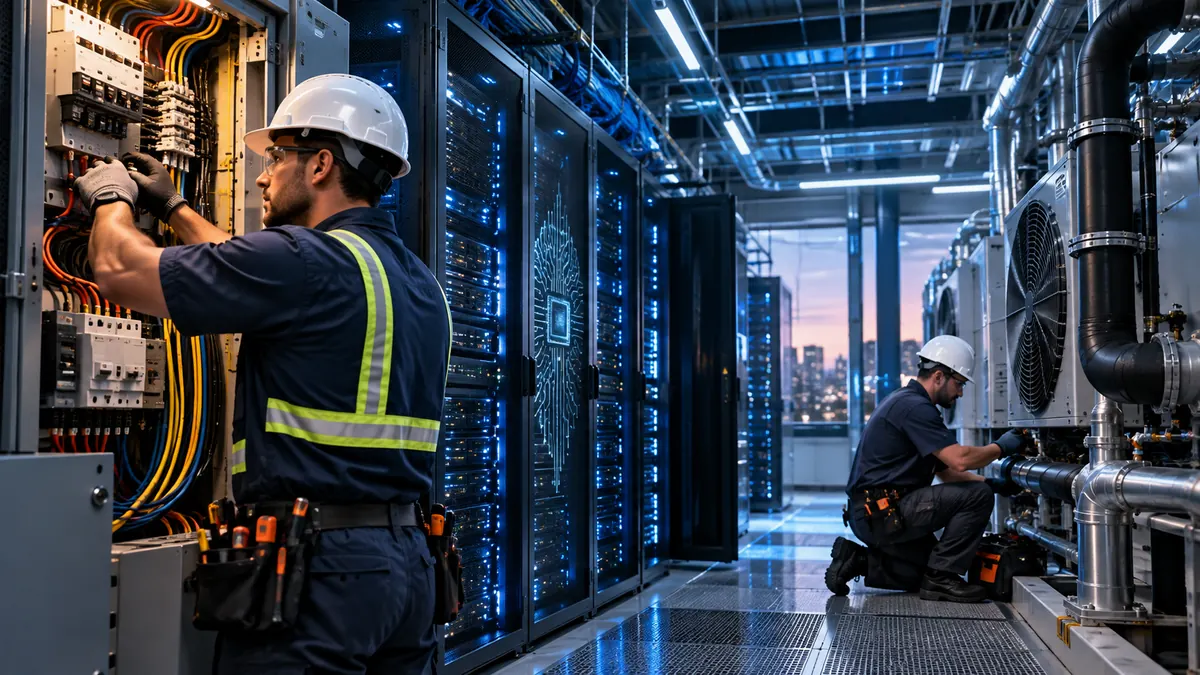
Generative AI feels like a purely digital product because users interact with it through websites and apps. Behind those interfaces, however, are data centers filled with servers, electrical equipment, cooling systems, backup power and networking hardware.
As AI workloads grow, companies need more computing capacity. That means building new facilities and upgrading the power systems that support them.
Rowe has repeatedly connected this infrastructure buildout with the need for skilled workers. In a June 2026 article about the American Workforce Academy, he wrote that the AI economy would require a very large infrastructure investment and hundreds of thousands of skilled workers. His September Build Freedom update also highlighted high-paying industrial and trade jobs that require training but not necessarily a four-year degree.
Electricians are a clear example
The U.S. Bureau of Labor Statistics now explicitly mentions artificial intelligence and data centers in its outlook for electricians. BLS says increased use of AI technologies and demand for data centers are expected to contribute to higher electricity demand, creating work connected to grid upgrades and new infrastructure.
BLS projects electrician employment to grow from about 821,000 jobs in 2025 to roughly 896,900 in 2035, an increase of 9% over the decade.
That does not mean every electrician job exists because of AI. It does show that AI infrastructure is becoming one of several factors affecting demand for electrical work.
Which skilled trades could benefit from AI infrastructure?
The strongest opportunities are likely to be in occupations connected directly to the physical systems AI facilities depend on.
- Electricians: installation, distribution, backup power and grid connections.
- HVAC and cooling technicians: data-center servers generate substantial heat and require reliable cooling.
- Construction workers: new data centers, substations and supporting facilities require physical construction.
- Industrial maintenance technicians: critical infrastructure needs inspection, repair and preventive maintenance.
- Welders and fabricators: industrial expansion creates demand for metalwork and equipment installation.
- Lineworkers and power specialists: grid expansion and new generation capacity require field work.
Are skilled trades really “AI-proof”?
No job should be treated as completely immune to technological change. AI can already assist tradespeople with diagnostics, scheduling, estimating, documentation, safety checks and predictive maintenance.
But assistance is different from full replacement.
An AI system can help diagnose a failing cooling unit, but someone still has to inspect the equipment and make the repair. Software can help design an electrical system, but trained workers still have to install, test and maintain it.
For that reason, the better description may be AI-complementary rather than AI-proof: technology can make skilled workers more productive while the physical portion of the job remains essential.
Why this matters for career choices
For years, students were often encouraged to view four-year degrees and knowledge-work careers as the safest route into the modern economy. Generative AI has complicated that assumption because coding, writing, analysis and other digital tasks can now be partially automated.
At the same time, shortages remain in many hands-on professions.
That does not mean everyone should abandon university for a trade. It means career planning should account for how exposed a job is to automation, how much local physical work it requires, training costs, wages, licensing requirements and regional demand.
Mike Rowe’s broader workforce argument
Rowe’s advocacy predates the current AI boom. His foundation has promoted vocational training and work-ethic scholarships for years. What has changed is that AI infrastructure gives the skilled-labor debate a new urgency.
In September 2026, Rowe wrote that the Pentagon-backed Build Freedom initiative was highlighting large numbers of open industrial-base jobs and that mikeroweWORKS had received funding for training scholarships.
His message is therefore broader than “AI will create trade jobs.” He argues that the U.S. already has a skills gap, and that AI-driven infrastructure expansion could make that shortage more visible.
What AI can change inside the trades
The skilled trades will not remain technologically static. AI could become part of everyday workflows in several ways:
- predicting equipment failures before a breakdown;
- helping technicians interpret diagnostic data;
- generating job estimates and material lists;
- improving scheduling and dispatch;
- assisting with building plans and compliance documentation;
- monitoring energy use and cooling performance.
The likely result is not a world where tradespeople ignore AI. It is one where the best workers use AI tools while continuing to perform tasks that require physical judgment and execution.
Bottom line
The Mike Rowe skilled trades AI impact story is important because it challenges the idea that AI affects every occupation in the same way.
AI may automate some digital tasks while simultaneously increasing demand for the electricians, technicians and builders needed to support AI infrastructure. Current BLS projections for electricians and the rapid expansion of data-center capacity support the idea that the physical side of the AI economy deserves much more attention.
Explore more on AI Finderz
Latest AI Tools → · AI Models & Versions → · AI Tools Directory →