

Last updated: October 8, 2026.
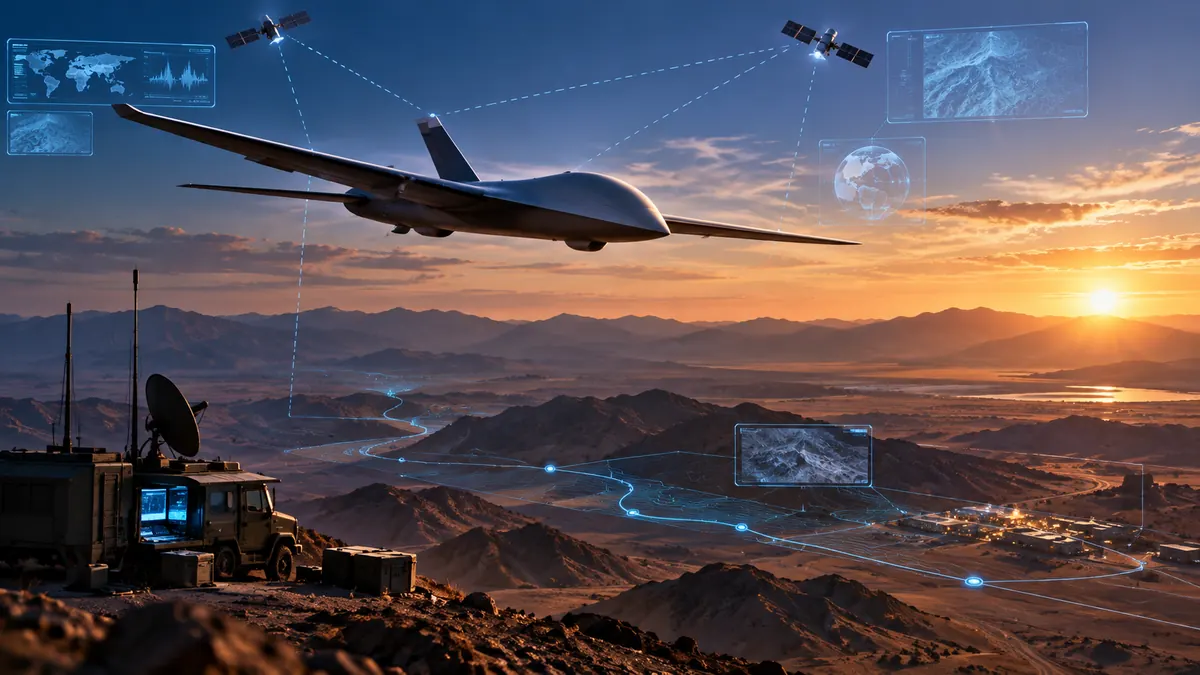
Harmattan AI has unveiled IRIFI, a new autonomous long-range defense system, as the company expands from tactical autonomous systems into what it calls “deep strike.” The announcement was followed by a new agreement in Morocco covering acquisition, development and local production of the system.
Quick answer: IRIFI is a Harmattan AI defense platform designed for long-range missions with autonomous execution after human authorization. Harmattan publicly lists a maximum range of up to 2,000 km. The company says human operators define the objectives and authorize launch before the autonomous phase begins.
What is Harmattan AI?
Harmattan AI is a French defense-technology company focused on autonomous military systems, mission orchestration and AI-enabled platforms. The company operates across several countries, including France, Morocco, Switzerland, the United Arab Emirates, the United Kingdom and the United States.
Its public portfolio spans air defense, persistent intelligence and surveillance, tactical strike, mission management and now long-range systems.
What is IRIFI?
Harmattan AI announced IRIFI on October 6, 2026. The company describes it as an autonomous long-range system designed to operate at strategic depth in contested environments.
The publicly released specifications are deliberately limited. Harmattan lists a maximum range of up to 2,000 km and says the platform uses onboard sensing, navigation and processing to continue a mission when communications or satellite navigation are degraded.
The company has not publicly disclosed the payload. This article therefore does not speculate beyond the manufacturer’s published information.
How much autonomy does IRIFI have?
One of the most important details in Harmattan’s description is the separation between human authorization and autonomous execution.
According to the company, human operators define mission objectives and approve the launch. The autonomous system then executes within those pre-authorized parameters. Harmattan presents this as a two-layer approach: human authority over engagement decisions combined with onboard autonomy during the mission.
That distinction matters because “autonomous weapon” can otherwise imply that software independently chooses strategic objectives. Harmattan’s published description instead emphasizes human-defined targets and authorization before autonomous execution.
What did Morocco sign with Harmattan AI?
On October 7, at the Marrakech Air Show, Morocco’s National Defense Administration and Harmattan AI Morocco signed a letter of intent related to IRIFI.
Moroccan reporting says the agreement covers the acquisition, development and production of IRIFI systems in Morocco. The signing extends a broader strategic partnership announced in June 2026, when Harmattan and the Royal Armed Forces of Morocco outlined plans for local manufacturing, defense-AI research and cooperation with Moroccan universities.
The financial value, final order quantity and delivery timetable have not been publicly disclosed in the sources reviewed for this article.
Why is Harmattan AI trending?
The timing explains the sudden rise in searches. Harmattan revealed a new product on October 6 and then appeared in news from the Marrakech Air Show the following day as the Morocco agreement became public.
The story also sits at the intersection of several fast-moving themes: defense AI, autonomous systems, sovereign manufacturing and the increasing role of software in military command-and-control.
What is confirmed — and what is not?
Confirmed publicly:
- Harmattan AI officially announced IRIFI on October 6, 2026.
- The company publicly lists a maximum range of up to 2,000 km.
- Harmattan says the system can execute an authorized mission autonomously using onboard sensing and processing.
- The company says mission objectives and launch require human authorization.
- Morocco and Harmattan AI Morocco signed a letter of intent on October 7 concerning acquisition, development and local production.
Not publicly confirmed in the reviewed material:
- the payload;
- the contract value;
- the number of systems to be acquired;
- a final delivery schedule;
- independent operational performance data.
Why this matters for AI
Harmattan’s announcement is another example of AI moving beyond software assistants into physical autonomous systems. In this context, AI is associated with navigation, sensing, mission execution and coordination rather than generative chat.
For the AI industry, defense applications raise a different set of questions from consumer tools: reliability under degraded communications, human control, accountability, export rules, sovereign manufacturing and how autonomous functions are constrained.
Bottom line
Harmattan AI’s IRIFI announcement is significant because it extends the company’s autonomy platform into a longer-range defense category while deepening its industrial partnership with Morocco.
The public information is still limited, so claims beyond the manufacturer’s specifications and the announced agreement should be treated cautiously. The most important facts today are the October 6 unveiling, the stated human-authorization model and the October 7 letter of intent with Morocco.