

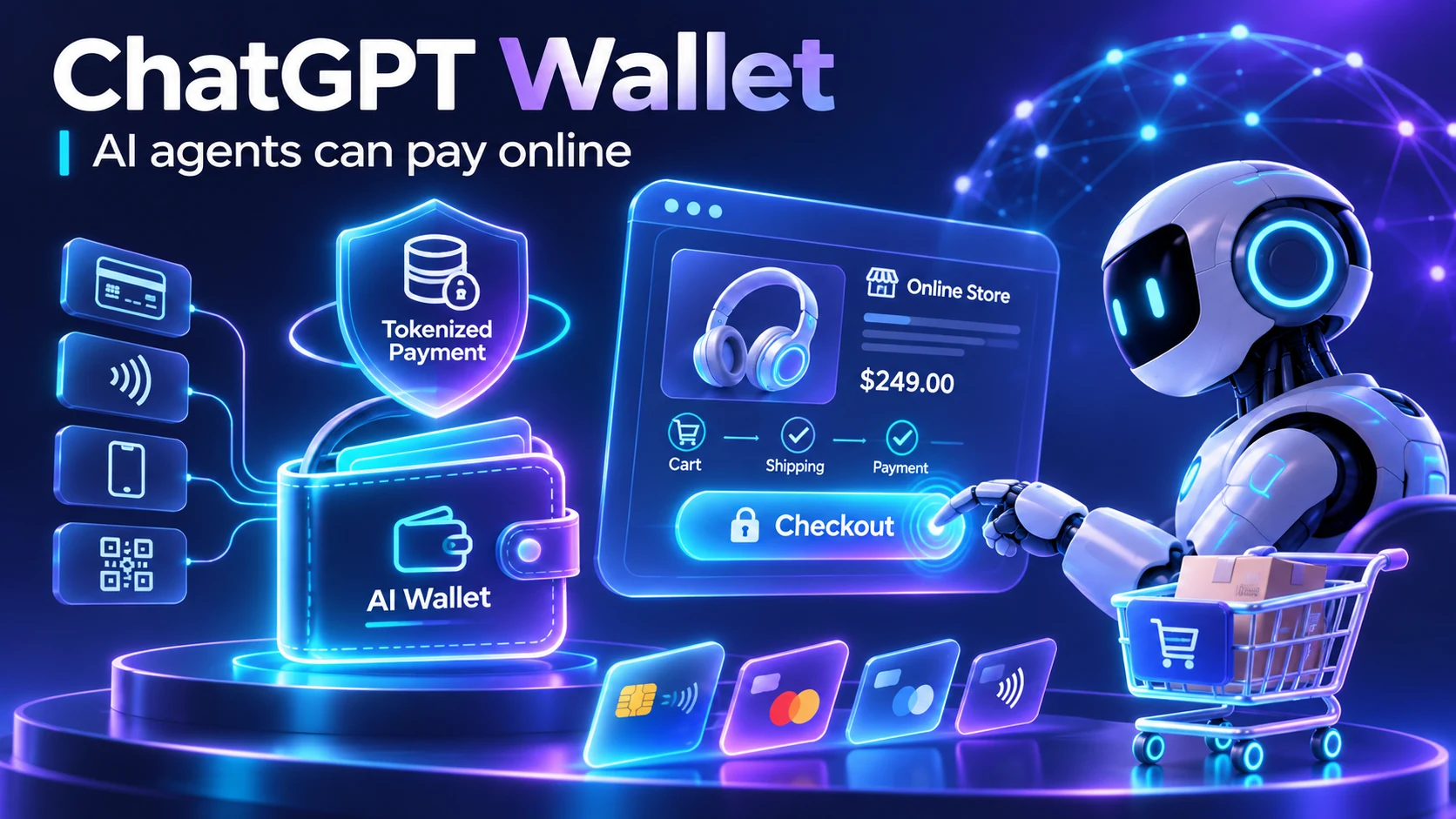
Quick answer: ChatGPT Wallet is OpenAI’s payment wallet for agentic shopping. It lets agents complete online purchases without receiving a user’s real card details. Each purchase requires a security check, and payment networks provide substitute credentials for the transaction.
What is ChatGPT Wallet?
ChatGPT Wallet is designed for a new phase of AI agents: moving from product research and comparison to completing a purchase. OpenAI says the wallet was built with major card networks and banking partners so an agent can pay while the user keeps control over authorization.
The initial rollout is for eligible ChatGPT Pro users in the United States through OpenAI’s dots. Availability is expected to broaden over time.
How an AI agent can pay without seeing your card number
The key idea is tokenization. The agent does not get the user’s actual card number. Instead, after the user approves the purchase, the payment network issues substitute payment credentials for that transaction.
- Add a card: the user stores an eligible card in the wallet.
- Review: before payment, the user checks the items, total and selected card.
- Approve: the purchase is confirmed with a security check such as biometrics.
- Pay: tokenized substitute credentials are generated and used for checkout.
Because the purchase still runs through existing payment rails, eligible rewards and dispute protections can remain available.
What changes for online stores?
OpenAI is also giving merchants guidance for agent-compatible commerce. A store does not necessarily need to rebuild its checkout from scratch, but it does need to avoid accidentally blocking legitimate agent traffic and make sure fraud systems can distinguish authorized agent purchases from suspicious automation.
For ecommerce teams, that means product feeds, accurate pricing and inventory, bot authentication, agent-readable pages and payment risk systems will increasingly become part of AI visibility.
Why this matters for agentic commerce
Until now, many shopping agents stopped before the final transaction. ChatGPT Wallet pushes agents closer to a full commerce loop: discover, compare, recommend, prepare the order and — after approval — pay.
This could make “agent-ready commerce” a practical SEO/GEO issue. Stores may need to optimize not only for humans and search engines, but also for agents that evaluate products and attempt checkout.
Who can use ChatGPT Wallet?
At launch, OpenAI says the feature is limited to eligible adult ChatGPT Pro subscribers in the United States with supported U.S.-issued cards. The company says broader access is planned.
FAQ
Can ChatGPT Wallet see my real card number?
The system is designed so agents use substitute tokenized credentials rather than the user’s actual card details.
Can an agent buy something without approval?
The current design requires a security check for every purchase. OpenAI has discussed future preapproved spending limits, but that is a different level of delegation.
Do merchants need a special payment processor?
OpenAI says the wallet is intended to work with existing payment systems, although merchants may need to adjust bot access and fraud controls.